
Transmission Belt Failure Modes and Correction Actions

Failure Mode Possible Causes Correction / Preventive Actions Additional Notes 1. Breaking 1. Overload 2. Too heavy inertia of driven pulley 3. Pulley diameter too small 4. Excessive initial tension 5. Belt crimped or operated improperly 6. Misalignment of belt axis 7. Foreign objects in the system 1. Check design, [...]
Read More

Storage & Maintenance of Transmission Belts

Proper storage and maintenance are essential to preserve the performance and lifespan of transmission belts. Even before installation, incorrect storage can lead to premature wear, deformation, or material degradation. The following guidelines ensure belts remain in optimal condition. General Storage Guidelines Avoid Sunlight and Heat: Store belts away from direct [...]

Read More

Installation & Maintenance of Transmission Belts

Transmission belts are essential components in power transmission systems, widely used in industrial machines, automotive engines, and agricultural equipment. Proper installation and maintenance are critical to ensure efficient operation, prevent premature wear, and maximize belt lifespan. This guide provides step-by-step instructions, tips, and visual aids to help beginners correctly install [...]

Read More

Conveyor Belt Troubleshooting Guide

Conveyor systems are complex machines with multiple moving parts, there are numerous conveyor belt issues that can derail your entire production process, which in turn will negatively impact your efficiency and profitability. This conveyor belt troubleshooting guide has been created by our experts to help you resolve some of the [...]

Read More

Solutions to common conveyor belt challenges

Conveyor belts and pulley systems play a key role in just about every industry you can imagine – from bulk handling in manufacturing plants to moving products at your local grocery store. As intelligent and reliable as these systems are, they do experience issues that can cost companies thousands of [...]

Read More

Properly Store Conveyor Belts

It is not uncommon for companies to stock extra belts in their plant in case of belt failure. No replacement belt is closer than the one you keep in storage. It is very important that these extra belts are stored properly. Here are a few storage rules to follow to [...]

Read More

Why do belt slip

What is belt slippage? Belt slippage occurs whenever torque demand exceeds the available friction between a V-belt and one or more of the pulleys (sheaves). When this occurs, the belt begins to slide backwards a bit as it moves with the pulley. This action is similar in two ways to [...]

Read More

V Belt Troubleshooting

Premature Drive V Belt Failure Symptoms Probable Cause Corrective Action Broken belts Under-designed drive Redesign the drive Belt rolled or pried onto sheave Use drive take-up when installing Object falling into drive Provide adequate guards or drive protection methods Severe shock load Redesign the drive to accommodate shock load Belts [...]

Read More

How to Indentify and Measure the Belt

Sizing Your V-Belts You need to determine the width and length of your industrial v-belts to select the correct replacement.  You can use the numbers on your old belt to determine the correct size or measure it yourself. V-Belt Width Measurements Single Belts Type of V-Belt Width of Belt (Inches) [...]

Read More

Length Calculation for V Belt

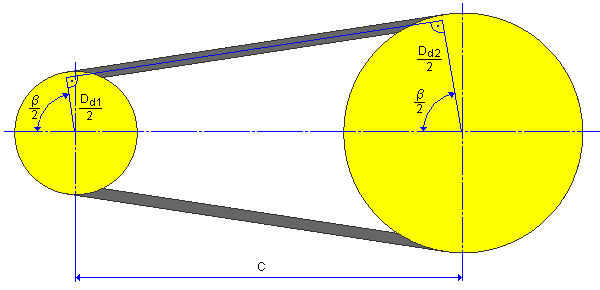
Length Calculation for V Belt Belt length is determined in a datum or effective system. For this reason the datum or effective diameters are determined first for each pulley. The belt trajectory is based on individual pulley position. The sliding pulley position is adjusted to accomplish standard belt length criteria. [...]

Read More